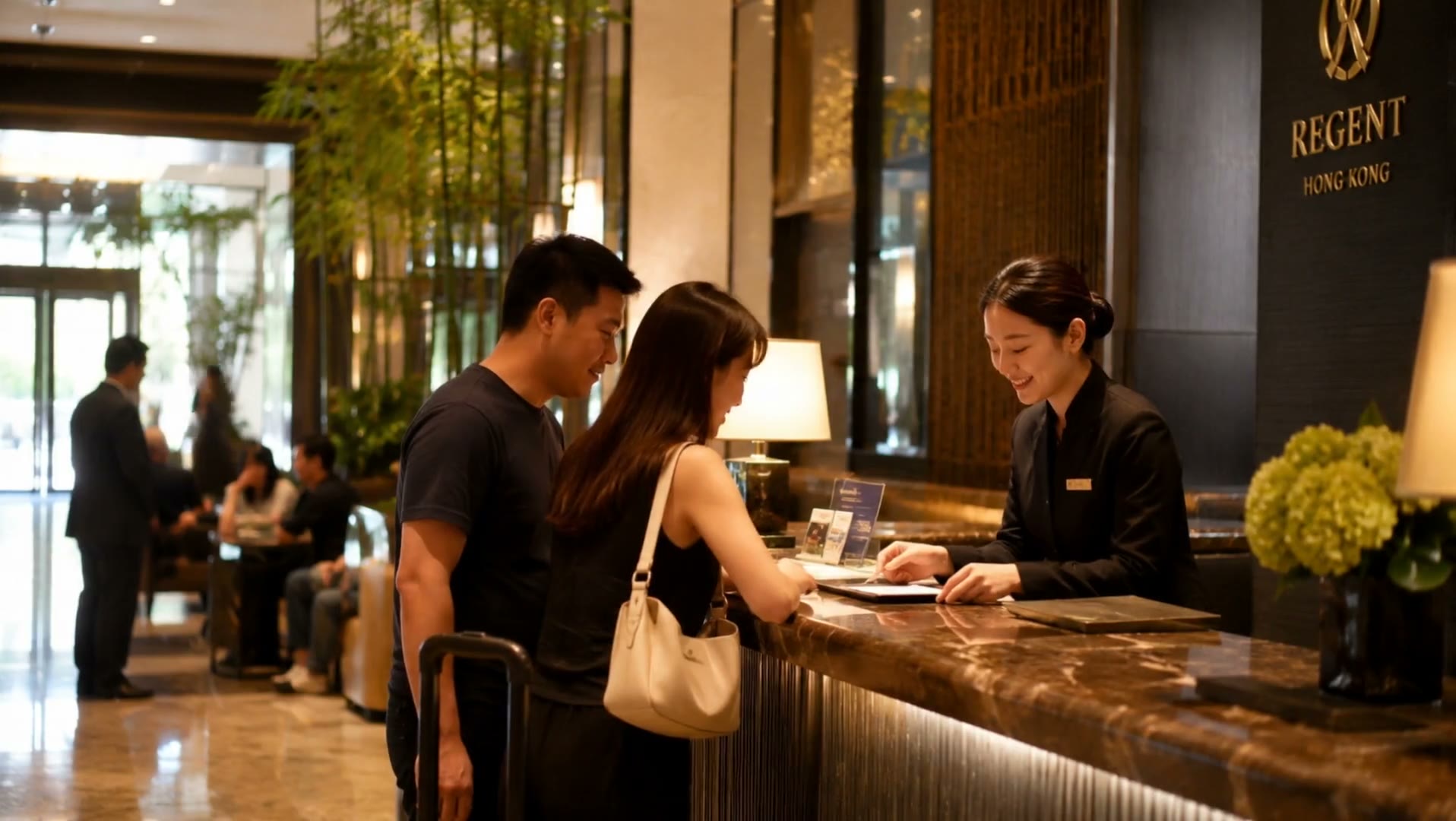
Every Outlet. One System.
What makes Hong Kong hospitality finance structurally different.
Running finance for a Hong Kong hospitality group isn't like running one restaurant or one hotel. Licences attach to premises, and liquor licences to a named person, so groups grow one company at a time. A twelve-restaurant group can sit on twenty legal entities before anyone mentions the central kitchen.

The demand came back. The economics didn’t.
Visitor arrivals vs real dining volume, indexed to 2018 = 100. Arrivals have climbed every year since reopening — dining volume peaked in the 2023 reopening year and has fallen two years running.
Arrivals recovered from 34M in 2023 to 49.9M in 2025. Real dining volume went the other way: 81.4 in 2023, 79.4 in 2024, 78.7 in 2025. The visitors returned; the dining didn’t follow.
Sources: HKTB / Tourism Commission visitor arrivals · C&SD Quarterly Survey of Restaurant Receipts and Purchases (provisional annual estimates). Volume index chained from C&SD annual volume % changes, 2018 = 100.
For the controller, that means a statutory audit for every company, group consolidation under the Companies Ordinance, quarterly Hotel Accommodation Tax returns on the hotel side, and payroll where tips and service charges feed every statutory calculation. On a stack of Xero logins and Excel, that's a real exposure. For the owners, it means nobody can say which outlets actually made money last week — and in a market that stopped growing while arrivals kept climbing, that answer decides whether you fix an outlet or quietly fund it for another season.

What Makes NetSuite the Right Platform for Hospitality Finance
Select a Benefit

Twenty companies shouldn't mean twenty logins and a consolidated spreadsheet built weeks after close. NetSuite OneWorld holds the full structure in one place, with outlet-level P&L, intercompany recharges, and consolidated numbers in real time.
- Consolidated financials across every entity in real time
- Outlet-level P&L that shows which sites make money
- Central kitchen and management recharges eliminated automatically
- Month-end close in days, not weeks
Twenty companies shouldn't mean twenty logins and a consolidated spreadsheet built weeks after close. NetSuite OneWorld holds the full structure in one place, with outlet-level P&L, intercompany recharges, and consolidated numbers in real time.
- Consolidated financials across every entity in real time
- Outlet-level P&L that shows which sites make money
- Central kitchen and management recharges eliminated automatically
- Month-end close in days, not weeks

POS totals, delivery payouts, and wallet settlements never agree by themselves. NetSuite posts sales at gross, clears every tender through its own account, and turns platform commission into a cost you can see and manage.
- Daily POS journals posted at gross, by outlet
- KeeTa and foodpanda payouts matched, commission visible
- Octopus, AlipayHK, and WeChat Pay HK settlement clearing
- Automated statement import from HSBC, Hang Seng, and BOCHK

Every operating company gets audited every year, and hotels now file Hotel Accommodation Tax quarterly. NetSuite's hard close keeps periods immutable once locked, so the records behind every filing stand up to scrutiny.
- Immutable audit trail with period locking
- Quarterly HAT figures straight from the ledger
- Statutory audit files for every outlet company
- Payroll data ready for 713 ADW calculations

F&B Track Record
Bakehouse Wholesale runs its growth on NetSuite.
When Hong Kong's best-known bakery built out its wholesale arm, PS Global implemented NetSuite Food and Beverage to run production, distribution, and the books in one system. Outlet costing, central kitchen operations, records that hold up: the requirements are the same ones every Hong Kong F&B group carries.
Regional NetSuite Leader
Why Choose PS Global?
As the region’s leading NetSuite provider, we offer the highest number of certified experts and top-rated client satisfaction in implementation and automation.
In 2023, PS Global (formerly ONE Pacific) earned the NetSuite Solution Provider – ERP Expertise accreditation, recognizing our excellence in project execution, technical proficiency, and measurable client success with NetSuite Cloud ERP.
Oracle NetSuite · Partner of the Year 2025
ASEAN Solution Provider

Popular Hospitality Integrations

Octopus
Octopus settles in daily batches with fees netted out and refunds delayed by days, so reconciling those deposits against NetSuite sales takes custom logic.

Hang Seng Bank
Import Hang Seng Bank statements into NetSuite with correct parsing for FPS, CHATS, and autopay transactions, plus separate handling for each currency sub-account.

Lalamove
Wire Lalamove dispatch confirmations and per-trip costs into NetSuite so you're not copying driver fees from one app to another after every delivery run.

Adyen
Adyen settlements bundle fees, FX conversions, and chargebacks into a single payout file that NetSuite can't parse without purpose-built decomposition logic.

HSBC
Parse HSBC statement files across your APAC entities, generate country-specific payment files for RTGS, BAHTNET, and direct entry, and handle cash pooling sweeps as inter-company entries in NetSuite.

Bank of China (HK)
BOCHK statement files come in MT940, BAI2, and CSV depending on the account and currency. Getting them all into NetSuite cleanly is the real project.
Showing 6 of 10 Hospitality Integrations

Hospitality Finance Insights


NetSuite for Hospitality and F&B
FAQ'sIt depends almost entirely on entity count and complexity. Two or three outlets, one bank, mostly card and cash: honestly, it may be too much at this stage, and we'll say so. Hong Kong has no small-company audit exemption, but a three-entity audit season is survivable on Xero.
Past eight or ten entities, with a central kitchen recharging outlets, six tender types settling on different schedules, and a group consolidation owed under s.379, the calculation flips. The cost of the current setup, in controller time and in what the spreadsheets hide, is usually already higher than it looks.
Yes, and it's a common path. OneWorld lets you add subsidiaries to an existing instance, so outlet companies join the same tenant as the holdco with consolidation across the whole group. The work is in the hospitality layer: POS journals, tender clearing accounts, and intercompany recharge flows that a corporate implementation never needed.
The caveat is the quality of the existing build. Clean chart of accounts and sensible segments make this straightforward; a generic rollout may need remediation first. We assess the existing instance as part of discovery.
The platforms pay you gross order value minus commission, refunds, and adjustments, on their own schedule. If you book the deposit as revenue, sales are understated and commission, one of your largest and fastest-moving costs, disappears into a netting entry nobody reviews. KeeTa's standard takeaway commission has run as high as 28 percent; that deserves its own line in the P&L.
In NetSuite, each platform gets a clearing account per outlet. The POS day posts at gross, the settlement clears against it, commission posts as a visible cost, and anything unmatched sits where someone can see it and chase it.
Yes, and you keep your POS. NetSuite doesn't replace Simphony, Infrasys, or Eats365 at the counter; it receives what they produce. The standard pattern is a daily sales journal per outlet: gross sales by category, tender-level takings into clearing accounts, voids and discounts as their own lines. How it arrives, via API or scheduled file, depends on the POS.
What matters is that the journal posts at gross with tenders split out. That's what makes settlement matching work downstream, and it's the part generic integrations most often get wrong.
Not exactly. The entity structure you have is the entity structure NetSuite is built for: each outlet company becomes a subsidiary in OneWorld with its own books, and the group view exists on top of them instead of in a spreadsheet. Current-year data migrates cleanly; prior years usually stay archived in Xero for audit reference rather than being rebuilt.
The real question is sequencing: whether to cut over at year-end, which is cleanest, or mid-year, which is faster. That's one of the things the discovery phase maps before you commit to anything.
A properly configured NetSuite implementation for a multi-outlet group is a real investment, in licensing and in implementation work, and we won't pretend otherwise. The discovery phase scopes the work and the number before you commit, so there's no open-ended bill.
Evaluate it against what the current setup costs: the finance team's week lost to settlement reconciliation, the audit premium for records assembled by hand across twenty companies, and the outlets that stayed open too long because nobody could see their real P&L.
Honest answer: no, and you shouldn't want it to. Hong Kong hospitality payroll runs on the Employment Ordinance's 713 average daily wage calculation, which drags tips and service charges into a rolling 12-month figure per employee, and the new 468 rule brings more casual staff into statutory coverage from January 2026. That belongs in a payroll system built for it.
NetSuite's job is what happens next: payroll posts as per-outlet, per-entity labour cost, so the number that decides whether a site is viable includes what it actually costs to staff it.
Service doesn't stop, so the implementation can't ask it to. The build runs alongside your current setup: new activity starts clean in NetSuite at cutover while legacy periods run to their natural close in the old system. Nobody runs a Saturday service while migrating that Saturday's books.
Phasing usually follows the structure: pilot on a small set of outlets, prove the POS journal and settlement matching, then roll the remaining entities in waves. The discovery phase maps that sequence before the build begins.
Since 1 January 2025, hotels and guesthouses collect 3 percent on accommodation charges and file a return with the IRD within 14 days of each quarter end. It lands on the operator, and the numbers have to reconcile to your accommodation revenue, net of the exempt categories, every quarter. That's a new recurring filing on a tight clock, four times a year.
NetSuite doesn't file the return; your team or your tax advisor does. What it provides is the figure: accommodation revenue isolated from F&B and other charges, by property, from a ledger where locked periods can't be quietly edited after the return has gone in.
OnePacific is now part of PS Global Consulting.
hk.psglobalconsulting.com is the dedicated Hong Kong NetSuite practice site for the same award-winning team clients knew as OnePacific, while psglobalconsulting.com covers the broader PS Global Consulting business across the region.
We continue to deliver NetSuite implementation, customization, integration, and support services for clients across Hong Kong and APAC.

Every outlet in view. Every tender accounted for.
We've configured NetSuite for multi-entity groups across APAC for 18 years. Tell us how your outlets are structured and we'll give you an honest read on whether it fits.